Kolhapuri Chappals: History, Craftsmanship, Styling Tips & Buying Guide
For over 800 years, Kolhapuri chappals have been more than footwear–they've been a symbol of craftsmanship, heritage, and timeless Indian style. Handmade by skilled artisans using traditional techniques, every pair carries a story that modern factory-made footwear simply cannot replicate.
Kolhapuri chappals are handmade leather sandals that originated in and around Kolhapur, Maharashtra, centuries ago. Made from vegetable-tanned leather and stitched entirely by hand, they're prized for their durability, breathability, and the way they get more comfortable the more you wear them. Today they carry a Geographical Indication (GI) tag, and genuine pairs are still made by artisan families using techniques passed down for generations.
If you've ever wondered why a pair of chappals can cost anywhere from a few hundred rupees to several thousand, or how to tell a handmade pair from a factory-made lookalike, this guide walks through everything. You will learn the history, the making process, how to choose the right pair, and how to keep them looking good for years.
What are Kolhapuri chappals?


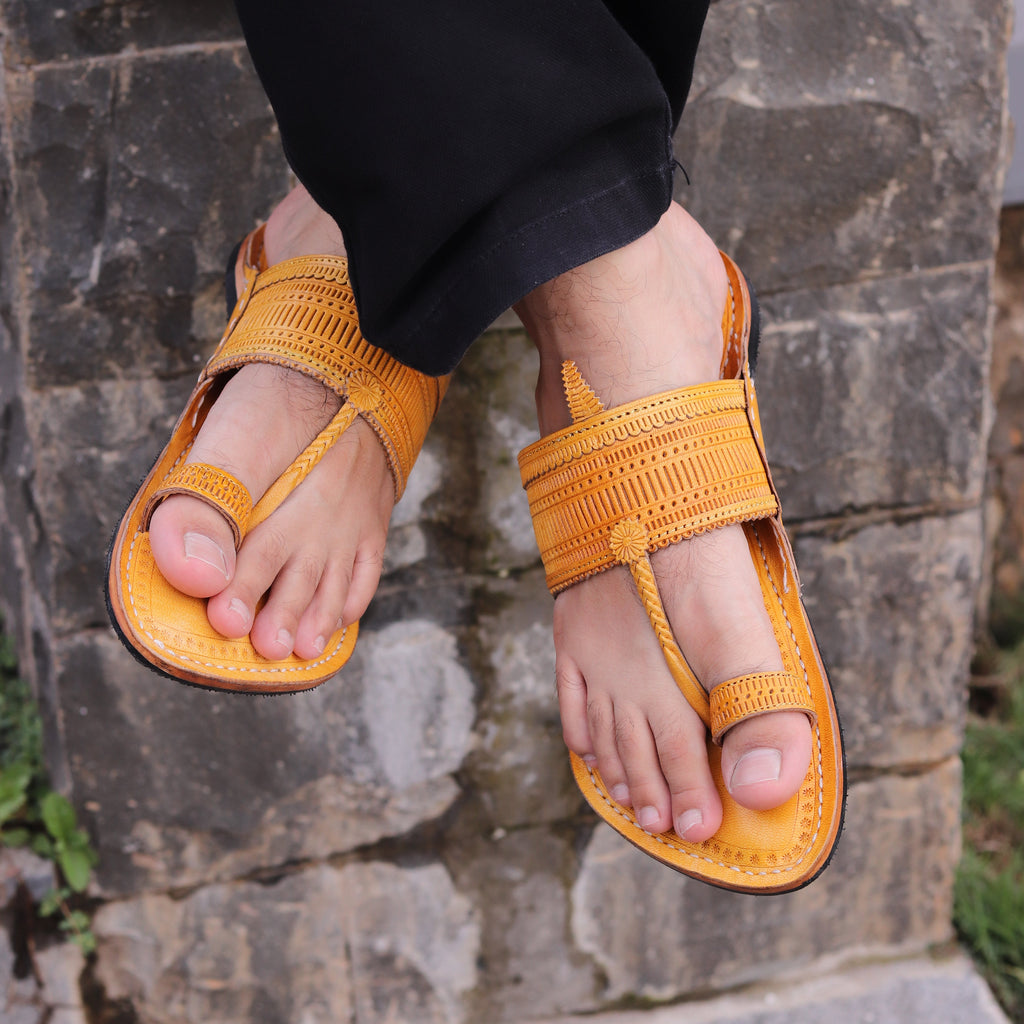
At their core, Kolhapuri chappals are open-toed leather sandals with a T-shaped strap design, hand-braided leather straps, and a distinctive flat sole. What sets them apart from ordinary leather sandals is the process. Every genuine pair is cut, stitched, and finished by hand using techniques that haven't changed much since the craft's early days in the Kolhapur region.
The name comes from the city of Kolhapur, which has been the heart of this craft since at least the 12th century, though some historians trace the Indian handmade footwear style even further back. In 2019, Kolhapuri chappals from Kolhapur and Sangli districts were granted a GI tag, which legally protects the name and confirms that authentic Kolhapuri chappals must be produced in this specific region using traditional methods. That tag matters because it's the clearest way to separate genuine craftsmanship from the mass-produced sandals that borrow the name without the process behind it.
Beyond the leather and stitching, there's a cultural weight to these sandals. In Maharashtra, they've long been associated with local pride, and you'll still see them worn at weddings, festivals, and everyday errands alike.
The history behind Kolhapuri chappals

The story of leather Kolhapuri chappals is really the story of the Charmakar and Dhor communities of Maharashtra and Karnataka. They developed leatherworking into a fine craft over centuries. Under the patronage of local royalty, particularly the Kolhapur princely state, these artisans refined their techniques, and the chappals became associated with status as much as utility. They were worn by nobles and farmers alike, just in different finishes.
What's kept the craft alive isn't documentation or formal training institutes; it's family. Skills move from one generation to the next, often starting with children watching their parents cut leather at home. A tanner's son becomes a tanner. A stitcher's daughter learns the awl and thread before she learns much else about the trade. This generational transfer is part of why the craft has retained so much of its original character even as fashion around it has changed.
Over the last few decades, Kolhapuris made the jump from strictly traditional footwear to a genuine fashion staple. Designers began pairing them with everything from jeans to lehengas, and international audiences took notice too. Kolhapuri-inspired sandals have shown up on runways abroad, sometimes controversially, given how little credit went back to the artisans who originated the design. That history is part of why buying from artisan-linked sellers, rather than anonymous factory lines, matters to the people who keep this craft going.
How handmade Kolhapuri chappals are made


Making a single pair of authentic Kolhapuri chappals often takes several weeks from raw hide to finished sandal. Here's roughly how it happens:
-
Leather selection: Buffalo, cow, or goat hide is chosen based on the intended thickness and flexibility. Sole leather needs to be thick and rigid; strap leather needs to be softer and pliable enough to braid.
-
Vegetable tanning: Instead of chemical tanning, traditional Kolhapuri leather is treated using natural agents like babul bark and myrobalan (harda). The hides are soaked, cleaned, treated with lime to loosen hair, then tanned over a period of days. This process is slower than chemical tanning but produces leather that ages well and is far gentler on skin.
-
Hand cutting: Artisans cut sole patterns and strap pieces from tanned leather sheets, often using nothing more than a curved knife and years of muscle memory to gauge proportion.
-
Stitching: This is where the real skill shows. Straps are hand-braided or woven, and everything is stitched together using waxed cotton or leather thread. There’s no glue holding the structural pieces together, which is one of the biggest tells of genuine handmade construction.
-
Finishing and polishing: The final sandal is shaped over a wooden last, edges are smoothed, and the leather is polished to bring out its natural tone. Some pairs get additional embellishment here like embroidery, metallic thread work, or beadwork, depending on the design.
Why genuine leather Kolhapuri chappals make a difference.


A lot of buyers ask whether the leather really matters, or if it's just marketing language. In practice, it matters quite a bit.
Genuine vegetable-tanned leather breathes. It lets air circulate around your foot, which matters a lot in Indian summers when synthetic footwear tends to trap heat and moisture. It also molds to your foot shape over time, so a pair that feels slightly stiff in week one usually softens into something closer to a custom fit by week four.
Durability is the other big factor. Good leather, properly tanned and cared for, can outlast synthetic soles by years rather than months. And because vegetable tanning avoids the heavy chromium salts used in some commercial tanning, the leather is generally considered a more sustainable and skin-friendly option, especially for people with sensitive feet.
Benefits of wearing handmade leather sandals
-
Comfort that improves with wear as the leather adapts to your foot instead of forcing your foot to adapt to it.
-
Breathable, natural material that offers far less sweat buildup compared to rubber or synthetic sandals.
-
Handmade quality so no two pairs are ever perfectly identical, which is part of the appeal rather than a flaw.
-
Long lifespan that can last several years with basic care.
-
Timeless design of the classic silhouette hasn't gone out of style in decades, and probably won't.
-
Lower environmental footprint as natural tanning agents and biodegradable materials compare favorably to plastic-based footwear.
KALAPURI DESIGNS - How to style Kolhapuri chappals
One of the reasons Kolhapuris have stuck around in Indian wardrobes is how easily they cross over between occasions.
Casual outfits

A simple tan or brown pair from Tatva collection works with jeans, kurtas, or cotton dresses just as well as it works with traditional wear. This is where most people start wearing them daily because they're genuinely comfortable enough for long days out.
Office wear
Understated, single-tone pairs with minimal embellishment can work in relatively relaxed office settings, especially paired with linen trousers or a simple kurta set.
 Understated, single-tone pairs with minimal embellishment can work in relatively relaxed office settings, especially paired with linen trousers or a simple kurta set.
Festive wear


This is where the more decorated designs come in. Our Rajsi Festive Flair collection offers chappals with gota work, beading, or coloured leather straps paired naturally with festive kurtas, sarees, or lehengas during Diwali, Ganesh Chaturthi, or wedding season.
Wedding looks

Brides and grooms in Maharashtra often choose richly detailed Kolhapuris as part of traditional wedding attire, and Kalapuri's bridal styles are designed specifically with that occasion in mind
Travel

Because they're flat, breathable, and don't require breaking in for very long, they hold up surprisingly well as travel footwear. They are much better than stiff synthetic sandals that tend to cause blisters on long walking days.
Men's Kolhapuri Chappals with minimal detailing pairs well with kurta-pajama or smart-casual pants. Women's Kolhapuri Chappals offer more range, from minimalist everyday styles to heavily embellished festive pairs.
How to choose the right Kolhapuri chappals
A few things matter more than they might seem to at first glance:
-
Size: Kolhapuri sizing can run slightly differently from regular shoe sizes because the strap structure fits differently than a closed shoe. If you're buying online, check the seller's specific size chart rather than assuming your usual size will match exactly.
-
Leather type: Ask whether the leather is genuine and vegetable-tanned, and whether it's buffalo, goat, or cow hide because each has a slightly different feel and flexibility.
-
Sole construction: A well-made sole should feel solid but not overly stiff. Press it gently; it should have a slight give without feeling flimsy.
-
Stitching quality: Look closely at the strap joins. Hand stitching tends to look slightly irregular in a good way with small variations that show a human hand did the work, as opposed to a machine-perfect but glued seam.
-
Colour and design: Traditional tan and brown are the classics, but Kolhapuris now come in a much wider palette, including bright festive colours and metallic finishes for occasions that call for something bolder.
-
Comfort on first wear: New leather can feel a little stiff initially. That's normal and expected but it's not a sign of poor quality, just a material that needs a short break-in period.
How to care for leather Kolhapuri chappals
A little maintenance goes a long way with genuine leather. Here's a simple routine:
-
If they feel tight, dip the straps briefly in water to soften the leather before wearing, just a couple of seconds is enough, not a soak.
-
Let them breathe. Avoid storing them in closed plastic bags or airtight boxes for long periods; leather needs some air circulation.
-
Address white bloom gently. A light white film that sometimes appears on leather isn't a damage, just brush it off with a soft, dry cloth.
-
Polish periodically. A light leather polish or natural oil every few weeks keeps the colour rich and prevents the leather from drying out.
-
Soften stiff spots with castor oil. A small dab worked into stiff areas helps restore flexibility without damaging the leather.
-
Be seasonal about it. Premium leather sandals are ideal for summer and pleasant winter weather, but it's best to avoid heavy monsoon use, since prolonged water exposure can weaken the stitching and leather over time.
-
Rotate pairs if you wear them often. Giving leather chappals a day off between wears helps them last longer, the same way it helps leather shoes.
How to spot authentic handmade Kolhapuri chappals
With so many machine-made sandals now sold under the "Kolhapuri" name, it helps to know what separates the real artisan made footwear from a look-alike.
|
Feature |
Handmade |
Machine-made |
|---|---|---|
|
Construction |
Hand stitched, no adhesive holding structure |
Glued joins, minimal stitching |
|
Material |
Genuine vegetable-tanned leather |
PU, synthetic, or low-grade leather |
|
Design |
Slight natural variation between pairs |
Uniform, identical finish |
|
Feel |
Softens and molds to foot over time |
Stays rigid, doesn't adapt |
|
Lifespan |
Several years with care |
Often a single season |
|
Smell |
Natural leather scent |
Often a plastic or chemical smell |
If a pair looks perfectly uniform down to the stitch, that's usually a sign it came off a machine rather than an artisan's workbench.
Why choose Kalapuri Kolhapuri chappals
Kalapuri's approach to Kolhapuri chappals is built around a few core commitments:
-
Working directly with artisan producer companies: sourcing happens through organised artisan producer groups in the Kolhapur region rather than layers of middlemen, so more of the value reaches the people actually making the chappals.
-
Empowering women artisans: a significant share of the stitching and finishing work is carried out by women artisans who've built specialised expertise in this craft over years.
-
Manufacturing in Kolhapur: production stays rooted in the region the craft originates from, rather than being shifted to unrelated manufacturing hubs.
-
Traditional production methods: hand cutting, hand stitching, and vegetable tanning remain central to how every pair is made, rather than being replaced with shortcuts for speed.
-
Quality control: each pair is checked for leather quality, stitching consistency, and finish before it reaches a customer.
-
Social impact: sourcing is built around consistent, fair work for artisan families rather than one-off or seasonal orders.
-
Preserving heritage: by keeping traditional techniques central to production, Kalapuri supports the continuation of a craft that could otherwise fade as cheaper machine-made alternatives dominate the market.
Real impact, in numbers:
-
Over 200 artisan families supported
-
Artisans working across 28 villages in the Kolhapur region
-
800 years of craftsmanship behind the technique
-
Around 2,000 handmade pairs produced
Collections like Rooprang bring colour and contemporary detailing to the traditional silhouette, while Bridal Kolhapuri Chappals and the Festive Collection carry richer embellishment for occasion-ready pairs. If jewellery is on your list too, the Kolhapuri Jewellery range follows the same regional heritage. Beyond sustainable leather footwear, learn more about the Kalapuri's artisan story and know what makes each pair special.
Frequently asked questions
What are Kolhapuri chappals?
They're traditional handmade leather sandals originating from the Kolhapur region of Maharashtra, known for their hand-braided straps, vegetable-tanned leather, and centuries-old construction methods. They carry a GI tag protecting their regional origin.
Why are Kolhapuri chappals famous?
They're famous for combining durability, comfort, and craftsmanship in a design that's remained largely unchanged for centuries, while also gaining traction as a fashion staple both in India and internationally.
Are Kolhapuri chappals made from genuine leather?
Authentic pairs are made from genuine leather (typically buffalo, cow, or goat hide) that is tanned using traditional vegetable-based methods rather than synthetic materials.
How are Kolhapuri chappals handmade?
The process involves hand-selecting leather, vegetable tanning, hand cutting patterns, hand stitching straps and soles, and finishing by polishing, and with no machinery replacing the core structural work.
How long do traditional Kolhapuri chappals last?
With reasonable care, a genuine handmade pair can last several years, especially compared to synthetic sandals that tend to wear out within a season or two.
Are Kolhapuri chappals comfortable for daily wear?
Yes, once broken in. The leather softens and molds to your foot shape over the first few wears, and the open, breathable design makes them comfortable for daily use, particularly in warm weather.
How do you style Kolhapuri chappals?
Simple tan or single-colour pairs work well with everyday casual and office wear, while embellished designs suit festive outfits, weddings, and traditional wear.
How do you care for leather Kolhapuri chappals?
Keep them dry, polish periodically, gently brush off any white leather bloom, use a little castor oil on stiff spots, and avoid heavy monsoon exposure.
How can you identify authentic Kolhapuri chappals?
Look for hand stitching rather than glued seams, genuine leather rather than synthetic material, slight natural variation between pairs, and the characteristic leather scent rather than a plastic smell.
Why choose handmade Kolhapuri chappals instead of factory-made sandals?
Handmade pairs offer better durability, natural comfort that improves over time, and support skilled artisan communities directly. The factory-made alternatives typically prioritize speed and cost over longevity or craftsmanship.